24 Sep 2026
Tracing Roulette Milestones and the Growth of Probability Frameworks Over Centuries
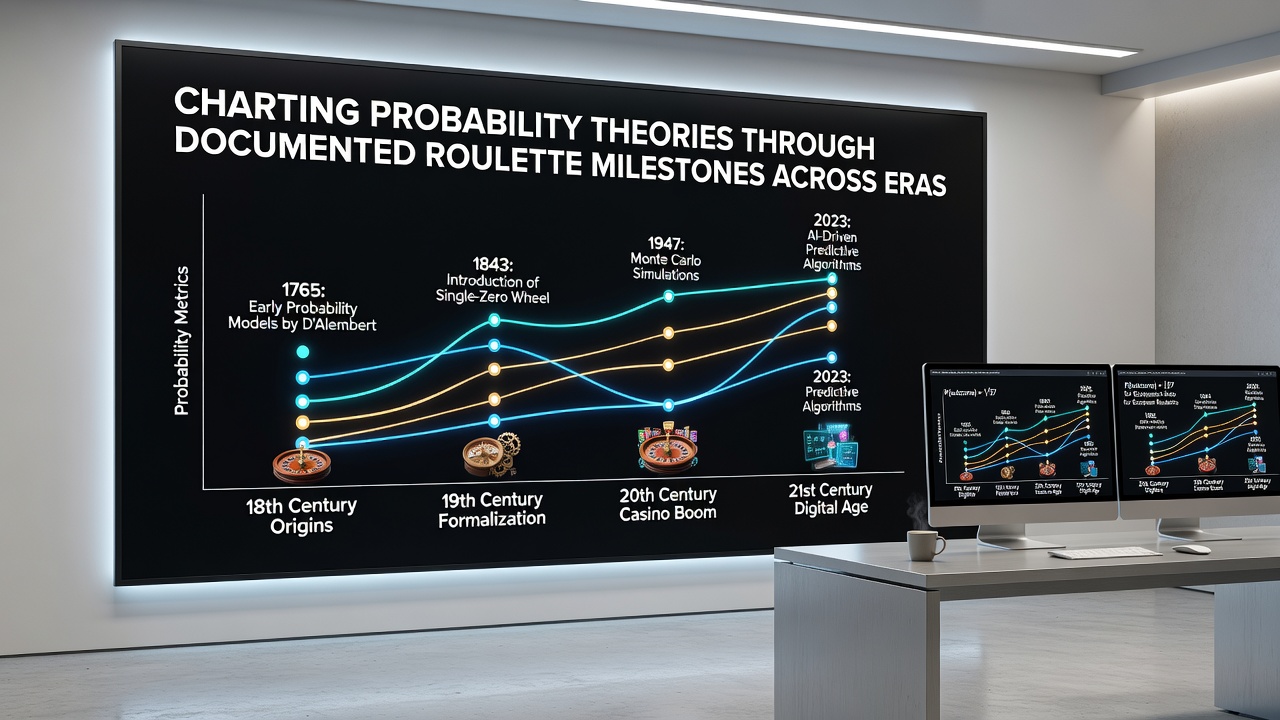
Historians trace the origins of the roulette wheel to 1655 when Blaise Pascal developed an early version during experiments aimed at perpetual motion devices, and this invention quickly intersected with emerging ideas in probability as mathematicians began documenting outcomes in games of chance. Data from early records show that by the late 1600s observers in France had started logging sequences of red and black results which laid groundwork for later statistical analysis. Researchers note that these initial tallies revealed patterns consistent with independent events rather than predictable streaks though many players at the time interpreted them differently.
Early Applications of Mathematical Principles to Roulette Records
During the 18th century Abraham de Moivre published works that applied probability calculations to roulette-style games and his equations demonstrated how the house edge remained constant across repeated spins regardless of previous results. Archival documents from Parisian gaming houses indicate that players who tracked thousands of spins in ledgers found distributions approaching theoretical expectations though deviations occurred in shorter sessions. Those who studied these logs observed that the law of large numbers began to hold more reliably as sample sizes increased which reinforced the separation between short-term variance and long-term averages.
19th Century Expansions and Casino Documentation
By the 1860s the opening of the Monte Carlo casino generated extensive records that probability theorists examined for insights into random processes and these datasets became foundational for studies on gambler's fallacy after the famous 1913 run of 26 consecutive blacks. Figures from that period reveal that betting volumes surged during perceived hot streaks yet overall returns aligned with the 2.7 percent house advantage built into the single-zero wheel. Academic analyses later confirmed that such events though rare fall within normal distribution curves when thousands of trials are considered.
What's interesting is how these documented sequences prompted mathematicians like Henri Poincaré to explore sensitivity to initial conditions in mechanical systems and roulette wheels offered tangible examples of chaotic behavior where tiny differences in ball release or wheel speed produced divergent outcomes. European archives contain correspondence between casino managers and statisticians who requested access to spin logs for verification purposes and such collaborations helped refine models of expected frequencies.
20th Century Advances Through Simulation and Data Collection
After the introduction of mechanical and later electronic roulette wheels in the mid-1900s laboratories began generating controlled datasets that allowed direct comparison between theoretical predictions and observed frequencies. Studies conducted at institutions in North America and Australia during the 1970s and 1980s demonstrated that physical imperfections in wheels could create measurable biases though regulatory standards eventually required regular calibration to minimize such effects. Data from these investigations showed bias detection required analysis of at least several thousand spins before statistical significance emerged.

Yet the arrival of computer modeling transformed how researchers approached historical milestones and programs simulated millions of spins in minutes to test systems that had once required years of manual recording. Reports from the Nevada Gaming Control Board illustrate how oversight bodies incorporated probability audits into licensing procedures ensuring that random number generators in electronic versions matched physical counterparts within specified tolerances. Industry organizations such as the European Gaming and Betting Association have compiled comparative studies across jurisdictions that highlight consistent application of probability principles despite regional variations in wheel design.
Contemporary Research and Planned Events in 2026
Recent work draws on large-scale online datasets where operators share anonymized outcome information under strict privacy protocols and analysts apply machine learning to identify any residual non-random elements. A symposium scheduled for September 2026 at a research center in Canada will examine digitized 19th-century roulette ledgers alongside current high-frequency trading data to explore parallels in stochastic processes. Participants from academic and regulatory backgrounds plan to review how documented milestones continue to inform updates in probability education and risk assessment models.
One study released by the Australian Gambling Research Centre compared historical bias cases with modern RNG certifications and found that transparency requirements have reduced exploitable edges to levels below detection thresholds in regulated environments. Observers note that these findings align with earlier conclusions from Laplace-era calculations while incorporating computational power unavailable to previous generations.
Conclusion
Across multiple eras documented roulette events have supplied concrete examples that refined probability frameworks from basic frequency counts to sophisticated stochastic models. Records kept by casinos governments and independent researchers demonstrate that core principles such as independence of trials and convergence to expected values remain consistent even as technology evolves. Events planned for September 2026 underscore ongoing interest in connecting past milestones with future analytical methods.